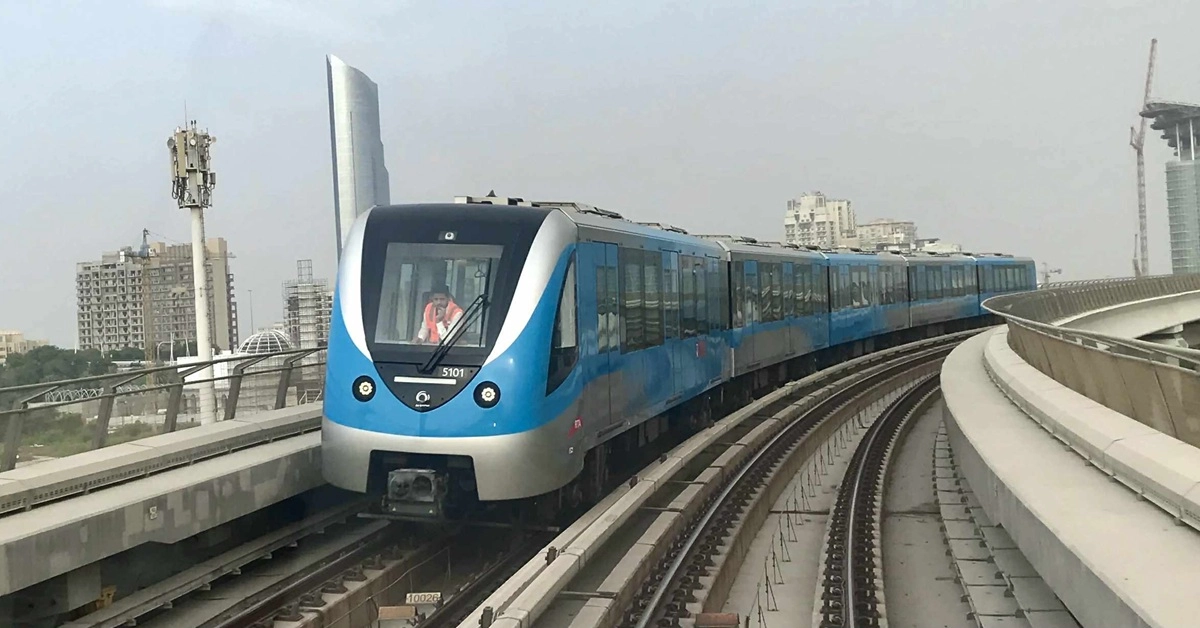

Dubai Metro operates 2 lines, 53 stations, and a total network length of 89.6 kilometres, making it the longest driverless metro system in the world.
The Red Line runs 52.1 kilometres across 29 stations.
The Green Line covers 22.5 kilometres across 24 stations.
Both lines connect across multiple fare zones with clearly numbered exits at each station.
What Is the Dubai Metro Red Line?
The Dubai Metro Red Line is a 52.1 km rapid transit route connecting 35 stations from Centrepoint (R11) in the east to Expo 2020 (R76) in the west. According to the Roads and Transport Authority (RTA) of Dubai, the line runs parallel to Sheikh Zayed Road for the majority of its length, serving as one of the most heavily used urban rail corridors in the Middle East.
What Types of Stations Does the Red Line Include?
The Red Line contains 3 distinct station types distributed across its 35 stops. The RTA classifies these stations by their structural position along the route:
- 24 elevated stations positioned above street level
- 1 ground-level station sitting at road grade
- 6 underground stations located below street level, including Deira City Centre, Al Rigga, Union, and BurJuman
How Is the Red Line Structured Between the Main Line and Branch?
The Red Line divides into 2 sections: a 31-station main line and a 4-station branch terminating at UAE Exchange (R42). The RTA designates these sections to distribute passenger flow across distinct corridors in the network.
What Zones and Key Destinations Does the Red Line Cover?
The Red Line crosses 5 fare zones, connecting major destinations including Dubai International Airport, Downtown Dubai, Mall of the Emirates, and the Expo 2020 site. Zone boundaries are defined by the RTA to regulate fare calculation based on travel distance.
Where Can Passengers Transfer Between the Red Line and Green Line?
The Red Line provides 2 interchange stations with the Green Line: Union (R18) and BurJuman (R19). These interchanges allow passengers to transfer between lines without purchasing additional tickets, per RTA fare policy.
Which Stations Do Express Trains Stop At?
Express train services on the Red Line stop at 4 designated stations: Centrepoint, Emirates, Al Rigga, and Emirates Towers. The RTA introduced express services to reduce travel time across high-demand segments of the route.
How Does Dubai Metro’s Fare System Work?
The Dubai Metro fare system charges passengers based on the number of zones crossed during a single journey, using a Nol card for payment. According to the Roads and Transport Authority (RTA), the network is divided into 5 zones, and the total cost is calculated by counting how many of those zones a journey passes through.
| Category | Attribute | Value |
|---|---|---|
| Single Zone | Fare Amount | AED 3 |
| Adjacent Zones | Fare Amount | AED 5 |
| Three or More Zones | Fare Amount | AED 7.50 |
| Lines Covered | Network Scope | Red Line and Green Line |
| Fare Updates | Status for 2026 | No changes reported |
What Nol Card Types Are Accepted for Zone-Based Fares?
The Silver Nol card and the Personal Nol card both apply the standard zone-based fare structure across all 55 operational stations. Both card types access the same pricing tiers, covering journeys through 1 zone, 2 adjacent zones, or 3 or more zones.
How Are Metro Stations Labeled Across Zones?
Each station carries an alphanumeric code, such as D4 for Business Bay or R71 for Discovery Gardens, identifying its zone placement on official RTA maps. The 2026 RTA metro maps include all 55 operational stations, extending along the Red Line to station R76, which serves the Expo 2020 site.
What Are the Dubai Metro Red Line Fare Options for Different Passenger Types?
The Dubai Metro Red Line offers fare structures tailored to tourists, frequent commuters, and eligible discounted groups, with costs ranging from AED 4 per zone to AED 350 per month. The Roads and Transport Authority (RTA) of Dubai published these fare tiers as part of its 2026 Nol card pricing framework, covering 4 distinct card categories across the Red Line network.
What Does the Red Ticket Cost for Tourists?
The Red Ticket charges AED 4 per single zone, with an additional AED 2 card issuance fee applied at the point of purchase. RTA fare data confirms the Red Ticket is capped at 2 zones per trip, making it suitable for short-distance journeys such as Union to BurJuman, Airport Terminal 1 to Deira City Centre, or ADCB to Mall of the Emirates.
- Paying AED 4 per zone for each trip segment
- Paying a one-time AED 2 card fee at purchase
- Limiting travel to a maximum of 2 zones per single trip
What Are the Best Fare Options for Frequent Commuters?
Frequent commuters benefit most from the Silver Nol card, which applies a daily spending cap of AED 14 and a monthly all-zones pass priced at AED 350. RTA ridership reports indicate these options reduce per-trip costs for passengers making more than 5 journeys per day or more than 22 commuting days per month.
| Category | Attribute | Value |
|---|---|---|
| Silver Nol Card | Daily fare cap | AED 14 |
| Silver Nol Card | Monthly all-zones pass | AED 350 |
| Silver Nol Card | Zone coverage | All zones |
Who Qualifies for Discounted Fares on the Red Line?
Students, seniors, and people of determination qualify for a 50% fare reduction through the Blue Nol card, as established under RTA Concession Policy 2026. RTA accessibility guidelines confirm that 3 passenger categories, including full-time enrolled students, residents aged 60 and above, and individuals registered under the People of Determination program, are eligible to apply for the Blue Nol card at any of the 47 Red Line stations.
- Presenting valid student enrollment proof for the student discount
- Presenting a national ID confirming age 60 or above for the senior discount
- Presenting a People of Determination registration card for the accessibility discount
What Are the Transfer Stations That Connect the Red Line and Green Line?
Union Station and BurJuman Station are the 2 transfer points connecting the Red Line and Green Line on the Dubai Metro network, according to the Roads and Transport Authority (RTA) of Dubai. Both stations serve as designated interchange hubs, allowing passengers to switch between lines without exiting the fare zone or purchasing a new ticket.
What Landmarks and Facilities Does Union Station Provide Access To?
Union Station connects passengers to 3 key destinations, confirmed by RTA station guides: Al Ghurair Centre, Dubai Creek, and Union Square Bus Station. The station supports multi-modal travel through integrated bus connections, including routes to Deira, Bur Dubai, and Al Ghubaiba Bus Terminal.
What Landmarks and Facilities Does BurJuman Station Provide Access To?
BurJuman Station connects passengers to 3 destinations, as listed in RTA published station maps: BurJuman Mall, Al Seef, and Dubai Museum. Integrated bus connections at this station support onward travel to neighborhoods such as Karama, Mankhool, and Al Raffa.
What Physical Features Do Both Transfer Stations Share?
- Providing air-conditioned transfer corridors maintained at consistent indoor temperatures
- Displaying clear directional signage in Arabic and English at all corridor junctions
- Offering integrated bus connections supporting multi-modal travel options, including feeder buses, intercity coaches, and taxi bays
- Maintaining coordinated scheduling that reduces interchange waiting times to under 5 minutes, based on RTA service frequency data
The Red Line Stops Worth Knowing and Why They Matter
Whether you’re catching an international flight, visiting the Burj Khalifa, or heading to a business meeting in the DIFC, the Red Line’s stops are strategically positioned to get you there without hassle. Airport Terminal 3 provides elevated access directly into the departures level. The UAE Exchange station anchors the southern terminus and serves as the primary boarding point for residents in Jebel Ali. Each station along the corridor connects to a specific district, commercial zone, or transport hub. Knowing which stops align with your plans means you’ll navigate Dubai more efficiently and confidently.
What Are the Key Stops Along Dubai’s Red Line?
The Red Line includes 35 stations spanning 67 km, with specific stops serving as primary navigation points across Dubai. The Roads and Transport Authority (RTA) operates this network, which connects airports, landmarks, business districts, and shopping destinations, including Dubai International Airport, Burj Khalifa, and Mall of the Emirates.
Which Stations Provide Direct Airport Access?
Stations R13 and R14 provide direct access to Dubai International Airport. The RTA confirms that these 2 stations are positioned to serve arriving and departing passengers without requiring transfers to additional transit lines.
Where Do You Board for Burj Khalifa and Dubai Mall?
Station R25, labeled Burj Khalifa/Dubai Mall, is the single boarding point for both the world’s tallest tower and its adjacent retail complex. The Burj Khalifa stands at 828 metres, and Dubai Mall covers 502,000 square metres of retail space, making R25 one of the highest-traffic stations on the Red Line, according to RTA ridership data.
What Stations Cover the Business Corridor?
Stations R22, R23, and R24 cover the full business corridor, serving facilities including World Trade Center, Emirates Towers, and Financial Centre. These 3 consecutive stations provide access to Dubai’s primary commercial zones along Sheikh Zayed Road.
Which Station Serves Mall of the Emirates?
Station R32 serves Mall of the Emirates, a major retail destination along the extended Red Line. Mall of the Emirates spans 223,000 square metres of leasable retail area, according to Majid Al Futtaim Group property records.
Where Does the Red Line Split into Branches?
Station R38, Jebel Ali, is the terminal point where the line divides into 2 branches serving Expo City Dubai and UAE Exchange. The RTA designates R38 as the bifurcation node for passengers requiring onward travel to either destination.
Why Do Certain Metro Stops Matter for Getting Around Dubai?
Certain stops matter because they provide direct access to high-traffic destinations, reducing travel time and eliminating the need for secondary transport.
Key stations, such as Terminal 1, Terminal 3, and Burj Khalifa/Dubai Mall, serve locations that handle tens of millions of visitors and passengers annually, according to Dubai Airports and Dubai Tourism authority records.
Which Airport Stations Save the Most Time?
Terminal 1 and Terminal 3 stations deposit passengers directly inside Dubai International Airport, removing the need for taxis or shuttle connections.
Dubai International Airport processes over 86 million passengers per year, according to Dubai Airports. Arriving at these stations eliminates transfer steps including taxi queuing, fare negotiation, and road congestion delays.
Which Station Serves Shopping and Sightseeing?
Burj Khalifa/Dubai Mall station connects directly to a complex receiving over 80 million visitors annually, according to Emaar Properties.
- Provides access to retail destinations, including Dubai Mall, the Dubai Fountain, and Burj Khalifa observation levels
- Reduces reliance on road-based transport during peak congestion periods
- Enhances navigation for first-time visitors unfamiliar with road layouts
Which Stations Serve the Business District?
Emirates Towers and Financial Centre stations connect the corporate corridor along Sheikh Zayed Road, serving business travelers commuting to offices, banks, and corporate headquarters.
| Category | Attribute | Value |
|---|---|---|
| Station | Business hub access | Emirates Towers |
| Station | Financial district access | Financial Centre |
| Corridor | Road served | Sheikh Zayed Road |
Which Stations Reach Suburban Residential Areas?
Al Furjan and Discovery Gardens stations provide access to suburban residential zones that private taxis frequently overcharge to service.
- Reduces transport costs for residents in areas including Al Furjan, Discovery Gardens, and adjacent communities
- Develops reliable commuting habits for workers traveling from outer residential zones
- Enhances budget management by replacing variable taxi fares with fixed metro pricing
How Do Operating Hours Develop Better Travel Planning?
The network opens at 5:00 AM daily and extends service until 1:00 AM on Fridays, aligning directly with early departures and late flight arrivals.
Operating hours structured around a 5:00 AM start and a 1:00 AM Friday close cover the majority of scheduled flight windows at Dubai International Airport, according to the Roads and Transport Authority Dubai. Travelers save measurable time and money by using fixed-fare metro access rather than late-night or early-morning taxi services, which apply surge pricing during those windows.
Which exits should you use on Dubai’s Red Line Metro?
The correct exit at each station saves walking time and connects you directly to Dubai’s top attractions.
According to the Roads and Transport Authority (RTA) of Dubai, the Red Line spans 52.1 kilometers and serves 29 stations, making exit selection critical for efficient navigation.
Which exit do you use at Burj Khalifa/Dubai Mall Station?
Exit 1 connects you to the Metro Link bridge, providing direct access to Dubai Mall and the Burj Khalifa.
Dubai Mall receives approximately 80 million visitors per year, according to Emaar Properties, making it the most visited retail destination globally. Take Exit 1, cross the climate-controlled Metro Link bridge, and arrive at the mall’s lower ground floor entrance without street-level navigation.
Which exit do you use at Mall of the Emirates Station?
Exit 1 on the left side connects you directly to Mall of the Emirates, which contains 630 stores including Ski Dubai and VOX Cinemas.
The mall covers 223,000 square meters of retail space, according to Majid Al Futtaim Group. Use Exit 1 to reach facilities such as Ski Dubai, VOX Cinemas, and Magic Planet without crossing external roads.
What can you access from Emirates Towers Station?
Emirates Towers Station provides walking access to the Museum of the Future and Sheikh Zayed Road’s commercial towers.
The Museum of the Future, opened in February 2022, sits approximately 800 meters from the station exit. Walk north along Sheikh Zayed Road to reach landmarks such as the Museum of the Future, Emirates Towers, and the World Trade Centre.
How do you use Union Station for connections or creek access?
Union Station functions as an interchange point connecting the Red Line and Green Line, and provides street-level access to Dubai Creek abra boats at a fare of 1 AED.
The RTA operates abra ferry services daily from 6:00 AM to midnight, according to official RTA schedules. Use the station to develop route options including Green Line connections, abra crossings, and access to Deira souks such as the Gold Souk, Spice Souk, and Perfume Souk.
What attractions do you reach from Max Station?
Max Station provides a 10-minute walking route to Dubai Frame and entrance to Zabeel Park at a cost of 5 AED.
Dubai Frame stands 150 meters tall and 93 meters wide, according to Dubai Municipality records. Exit the station and walk 800 meters to reach destinations such as Dubai Frame, Zabeel Park, and the park’s outdoor recreational zones.
What Districts Does Dubai’s Red Line Cover at Each Station?
Dubai’s Red Line covers 31 main stations plus 4 branch stations across 52.1 kilometers, connecting districts including Airport City, Downtown Dubai, and Jebel Ali.
According to the Roads and Transport Authority (RTA), the Red Line operates across elevated and underground segments, serving commercial, residential, and transit zones across the city.
Which Stations Serve the Airport and Eastern Zones?
R11 Centrepoint functions as the airport eastern terminus, anchoring the line’s eastern end near major travel hubs.
The eastern corridor includes underground platforms at stations such as R13 Airport Terminal 3 and R16 City Centre, serving transit zones including airline connections, cargo facilities, and passenger terminals. The track configuration develops between elevated and underground formats across this segment.
| Category | Attribute | Value |
|---|---|---|
| Eastern Terminus | Station Code | R11 Centrepoint |
| Underground Zone | Stations Covered | R13 to R16 |
| Line Format | Track Type | Elevated and underground |
Which Stations Provide Green Line Interchange Access?
R18 Union and R19 BurJuman each provide direct Green Line interchange access, giving commuters 2 dedicated transfer points across the network.
The RTA confirms both interchange stations serve high-traffic zones including Deira, Bur Dubai, and central retail corridors. Commuters can board Green Line services at either station without exiting the paid zone.
- Connecting at R18 Union: access routes toward Deira, Al Qiyadah, and Creek stations
- Connecting at R19 BurJuman: access routes toward Oud Metha, Dubai Healthcare City, and Jaddaf
Which Station Serves Downtown Dubai and Major Attractions?
R25 Burj Khalifa/Dubai Mall functions as the primary Downtown gateway, positioned within 300 meters of the Dubai Mall entrance.
According to the RTA’s network map published in 2023, this station records among the highest boardings on the Red Line, serving landmarks including the Burj Khalifa, the Dubai Fountain, and the Dubai Mall retail complex. Foot traffic at this station enhances connectivity for tourists and business travelers.
Which Stations Cover Sheikh Zayed Road’s Business District?
R23 Emirates Towers serves the Sheikh Zayed Road business corridor, providing direct access to commercial towers including Emirates Towers, Al Habtoor City, and adjacent corporate offices.
Stations along Sheikh Zayed Road develop connectivity for professional zones including finance centers, hospitality venues, and government offices. The elevated track format along this corridor provides unobstructed city views across 7 continuous stations.
Where Does the Southern Branch Extension Terminate?
Stations R70 through R76 form the southern branch extension, reaching the Expo 2020 site opened to the public in October 2021.
The RTA confirmed the branch fork originates at R38 Jebel Ali, splitting the line to serve southern districts including Dubai South, Expo City Dubai, and the Al Maktoum International Airport zone. The branch covers 15 kilometers beyond the main Red Line corridor.
| Category | Attribute | Value |
|---|---|---|
| Branch Fork Station | Station Code | R38 Jebel Ali |
| Southern Extension | Station Range | R70 to R76 |
| Branch Length | Distance Covered | 15 kilometers |
Red Line Park-and-Ride, Bus Links, and Onward Travel Tips
If you’re driving to the metro, free park-and-ride facilities are available at both ends of the Red Line. Centrepoint Station near Dubai International Airport accommodates 2,700 vehicles, while Jabal Ali Station on the western end handles up to 3,000. These endpoint locations also anchor the line’s broader transit connections. Several stations double as bus connection hubs, with Centrepoint (R11) linking to both Al Rashidiya and Rashidiya Bus Stations for regional routes. Al Jafiliya, Al Safa, and Mall of the Emirates stations each connect to dedicated bus terminals, making multi-modal trips across Dubai straightforward from a single transit point.
Where Are the Red Line Park-and-Ride Facilities Located?
The Red Line has 2 park-and-ride facilities, located at Centrepoint Metro Station (R11) and Jabal Ali Metro Station (R75). Dubai’s Roads and Transport Authority operates both sites, offering free parking to commuters who scan a Gold or Silver Nol card at the entrance barrier.
Which Park-and-Ride Facilities Does the Red Line Offer?
| Category | Attribute | Value |
|---|---|---|
| Facility 1 | Name | Centrepoint Metro Station (R11) |
| Facility 1 | Location | Rashidiya, near Dubai International Airport |
| Facility 1 | Capacity | 2,700 vehicles |
| Facility 2 | Name | Jabal Ali Metro Station (R75) |
| Facility 2 | Location | Al Quoz, west of Dubai Marina |
| Facility 2 | Capacity | 3,000 vehicles |
What Are the Key Features of Each Facility?
Jabal Ali Metro Station holds 300 more vehicles than Centrepoint, making it the larger of the 2 facilities. Each location offers distinct connections to surrounding destinations, including shopping centres, residential districts, and transit corridors.
Centrepoint Metro Station features:
- Proximity to retail destinations, including City Centre Mirdif and Arabian Center
- Access to Rashidiya, a residential and commercial district near Dubai International Airport
Jabal Ali Metro Station features:
- Connection to the main Red Line and the Route 2020 branch
- Positioning west of major waterfront districts, including Dubai Marina and Jumeirah Beach Residence
What Bus Connection Options Are Available at Dubai Metro Stations?
Dubai Metro stations connect passengers to extensive bus networks, tram lines, and shuttle services across the city.
According to the RTA’s official network data, the Dubai Metro integrates with more than 140 bus routes, covering residential, commercial, and industrial zones across Dubai.
Which Bus Connections Does Rashidiya Station (R11) Offer?
Rashidiya Station connects passengers to local bus routes through Rashidiya Bus Station.
- Access local routes, including residential services, feeder buses, and community lines
- Use your Nol card for seamless transfers at the adjacent bus terminal
Which Bus Connections Does Emirates Station (R12) Offer?
Emirates Station links passengers to airport buses and area-specific services, including Dubai International Airport routes and Festival City lines.
- Board airport-bound buses, such as Route 401, Route 402, and Route 420
- Access Festival City services directly from the station exit
What Shuttle Services Are Available at Airport Terminal 3 (R13)?
Airport Terminal 3 Station provides direct shuttle buses serving international and transit travelers.
- Connect to terminal shuttles, such as inter-terminal transfers, hotel buses, and airline crew routes
- Use this station as a priority entry point for air travel connections
What Bus Options Exist at Mall of the Emirates Station (R32)?
Mall of the Emirates Station includes a dedicated bus station with links to destinations such as Global Village, Al Barsha, and surrounding districts.
- Board seasonal services, including Global Village shuttles, feeder routes, and express lines
- Access the bus station directly through marked metro exits
What Connections Are Available at Dubai Marina Station (R36)?
Dubai Marina Station connects passengers to the Dubai Tram and bus services, including Marina Mall routes and JBR-area lines.
- Transfer to the Dubai Tram, covering 11 stops across Dubai Marina and JBR
- Board Marina area buses, such as the Route 8 feeder, Route 84, and Marina Mall shuttles
What Industrial and Special Zone Buses Depart From Branch Line Stations?
Branch line stations serve specific employment and event zones, including Jebel Ali Industrial Area and Expo City.
- UAE Exchange Station (R42) provides routes to industrial destinations, such as Jebel Ali Industrial Area, Port Jebel Ali zones, and free zone facilities
- Expo 2020 Station (R76) operates Expo City shuttles, such as site connector buses, event transport, and district loop services
How Do You Pay for Bus Transfers at These Stations?
Your Nol card covers all bus and metro transfers without requiring separate ticketing.
- Tap your Nol card at bus readers, including yellow card readers, gate validators, and handheld devices
- Check real-time bus schedules using the RTA app, available at all 3 fare zones within the metro network
| Category | Attribute | Value |
|---|---|---|
| Payment Method | Card Type | Nol Card |
| Schedule Tool | Platform | RTA Mobile App |
| Transfer Coverage | Network Scope | Metro, Bus, and Tram |
Final Words
Dubai’s Metro system operates across 2 lines, 53 stations, and covers over 90 kilometers of track. The Red Line spans 52.1 kilometers across 35 stations, making it the longer and more transit-critical of the two lines. Exit numbers at each station are assigned sequentially and correspond to specific street-level landmarks, fare zones determine ticket pricing across 6 designated zones, and transfer stations connect the Red Line to the Green Line at Union and BurJuman stations. Riders access the network using a Nol card, available in 4 categories: Red, Silver, Gold, and Blue. Station maps with exit numbers are available at all 53 stations and through the RTA’s official app.